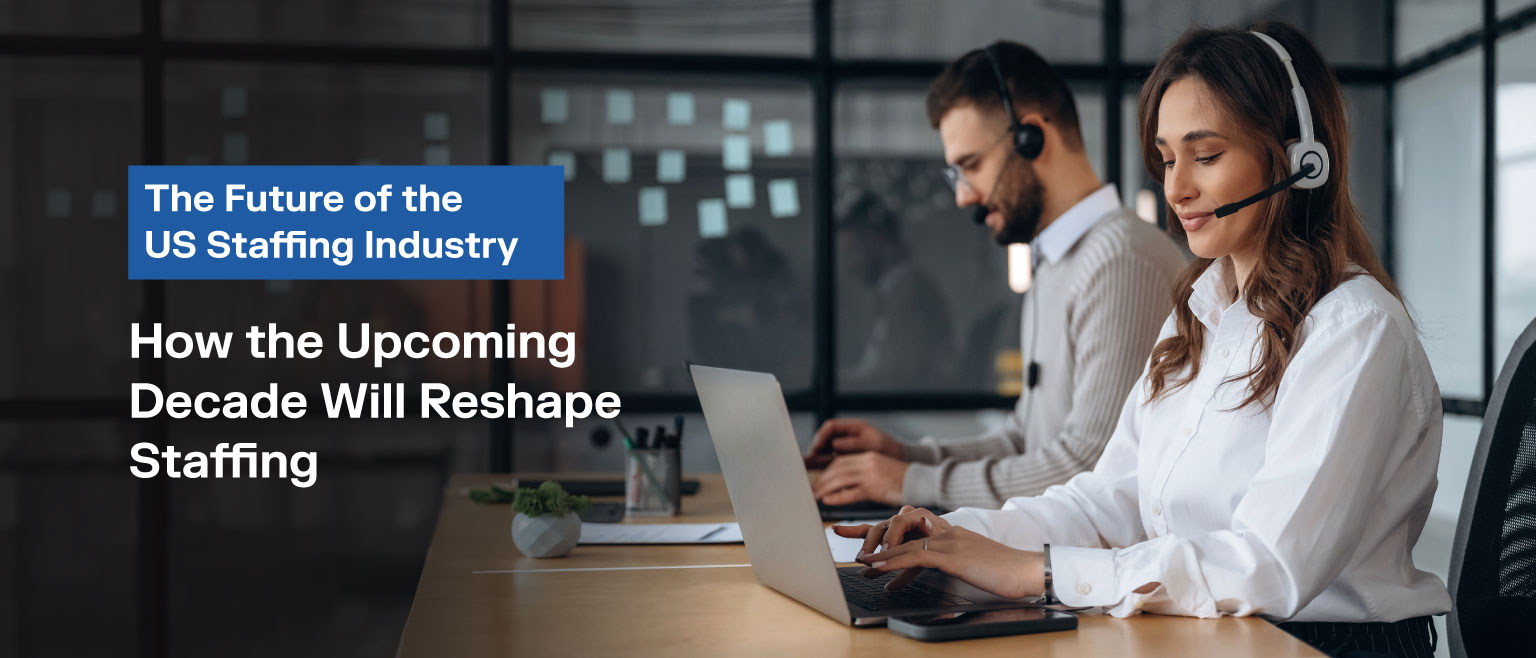
The Future of the US Staffing Industry: How the Upcoming Decade Will Reshape Staffing
Historically, staffing has correlated directly with the demand for hiring. Rapid business growth necessitates hiring new employees. Slow business growth results in layoffs. Economic growth dictated staffing trends. However, a more complex era is upon us.
The next decade will create a new era of talent, skills, and workforce design. Ultimately, we are beginning to see a paradigm shift in employment, away from hiring employees for jobs, and towards creating employed workforce units for skill functions.
For staffing firms, companies, and job seekers, the impact will be enormous.
The Staffing Revolution
One of the major advanced staffing paradigms is the employment of skills-based hiring. For a long time, hiring managers placed great confidence in degrees, years of employment, and former employers as indicators of capability. While those factors still matter, they are no longer enough in a business environment where technologies, tools, and job requirements are evolving and changing rapidly.
Today, employers are asking the following:
- Can they solve the problem?
- Can they work with new technologies?
- Will they be useful on the first day of work?
Skills-based employment is particularly evident in the technology, health care, engineering, and other professional services employment sectors. It is becoming more likely that organizations will see skills-based assessments employed as a quality hiring gain.
The Talent Shortage Discussion Is Changing
For many years, talking about hiring meant discussing talent shortages. Situations where talent is scarce remain, but the problem is more complex these days. The pool of applicants is plentiful. Individuals who possess the apt skill set, are trainable, and possess a business mindset are in short supply. Recruiters are contacting applicants in droves. Positions that once received a reasonable number of applications now get hundreds or even thousands of applications. Determining which of the many applicants is suitable remains just as challenging. The problem has now become locating suitable applicants.
Flexible Workforce Models Set to Become Standard
The most substantial workforce change in recent years has been the normalization of flexible talent models. In the past, companies built teams exclusively through permanent employees. This is no longer the case. Now, a mixture of full-time staff, contract employees, consultants, specialists who work on a project basis, and contingent employees is being integrated to provide a workforce that is more flexible and easier to change. This focuses on a new value that businesses are coming to appreciate: flexible systems. Whether a business is scaling to a new level, transforming the way it uses technology, or bringing in specialized knowledge, there is a business case for workforce flexibility. Because of this, staffing partners are becoming more important for workforce planning and not just hiring.
AI Will Transform Recruitment, but Judgment Will Always Be Human
Not much has been able to create such widespread conversation as artificial intelligence. Artificial intelligence is beginning to automate tasks like talent sourcing, candidate screening and matching, and analyzing talent pools for insights, all of which save recruiters time, especially as large numbers of job applications become the norm. Interestingly, the opposite is taking place as technology continues to advance. What has become clear is that the more automated the hiring practices become, the more significant judgment and the human element become.
Clients realize that recruiters are the best option for evaluating traits such as motivation, communication style, culture fit, and gaps, and the potential to lead and to stay, as these traits often are not captured in a resume, nor can they be identified by an algorithm.
Technology is propelling recruitment processes. However, it will never replace relationships, trust, and expertise, all of which are essential for recruitment decisions.
The Evolution of Staffing Firms: Workforce Consultants
The staffing firms that are a success in the next decade will not look like the firms that are a success in the current decade. This is because clients are looking for support with their own strategic workforce planning, and with things such as market talent and skills mapping, talent retention, and future hiring. As they seek strategic partners, clients care about the current reality of the workforce, especially the one that is yet to come.
The Future of Employment Consulting
The market is moving away from staffing solutions that fulfill an organization’s need to connect with potential employees, and is moving toward staffing solutions that fulfill an organization’s need to gain actionable insights. The next decade in employment will be defined by organizations’ abilities to create adaptive and robust workforces rather than focusing on filling open positions on time. The ability to adapt, innovate, and pivot will differentiate organizations in the marketplace. AI will disrupt hiring. Staffing firms will disrupt the way that organizations do business. Skills will continue to outweigh degrees. Flexible workforces will be a market differentiator. The organizations that thrive will be those that view talent not as a hiring challenge, but as a long-term business strategy.
Related Blogs
Learning Is No Longer an HR Function. It’s a Business Strategy
For decades, learning and development was largely viewed through the lens of human resources. Training calendars were prepared, programmes were conducted, attendance was recorded, certifications were issued, and completion percentages…
Building Human-Centric Organizations in an AI-Driven World
Artificial Intelligence is redefining the way organizations operate, accelerating innovation, improving decision-making, and transforming business processes across industries. While technology continues to evolve at an unprecedented pace, one principle remains…
The Future of Candidate Assessment in an AI-Generated Resume World
Recruiters used to spend a lot of time looking at resumes. A good resume can tell you about a person’s work history, what they have done, and what they can…